

In recent months I have had the opportunity to review the customer strategies for six organisations. There is a common theme. They are all bland.
It is as if they had to have a “Customer Strategy” and therefore, form a team and develop the customer strategy. Smash it out (because we are all busy). Ticked the box that we now have a customer strategy, and move on. This might seem a little harsh, but this is what these strategies look like.
This article is about how you can make sure your Customer Strategy is fit for purpose
The top three reasons why Customer Strategies are “bland”:
1. The descriptions of “customers” or “clients” is generic. Generally listing the types of customers you have or interact with, provides no insights in to what the strategy should be with these customers.
2. There are no clear outcomes from the customer strategy. A strategy is about changing the current situation. Otherwise, it is more of the same, continue with business-as-usual. Once the outcomes are clear: (a) it is easy to design and select meaningful performance measures for those outcomes; (b) have a specific focus for change (the outcome and the measures). Improvement initiatives can be developed that are on-point.
3. There is no cost/benefit analysis or prioritisation. If we say in the strategy that we intend to ”improve the service provided to customers” or “encourage more customers to be advocates of what we do”. Then what is the payback for these (vague) improvement efforts. With no understanding of the value specific customer groups bring to you, how can you ensure you are investing effort (time and money) into the optimal initiatives? Additionally, just because you developed 16 initiatives, does not mean you should implement all of them. You need to prioritise.
Why Your Business Needs a Customer Strategy
Let’s take a deeper dive into how to prevent these three flaws and ensure your Customer Strategy is fit for your purpose…
1: The “Customer” is generic.
Not all customers are equal. They are not equal in the value they bring to you, and in the value they seek from you.
Customers that use a particular service you offer, or buy a product from you, are not all the same. Particularly in the value they return to you. Either financially or through word of mouth.
Understanding this two-way value exchange and the differences in these customers is key to growing the value of your customer portfolio. We when analyse customer portfolios we typically find that 80% of the value comes from 20% of the customers (yes, the Pareto Principle remains relevant). And in fact, it is often that 90% of total value comes from around 10% of the customer base.
The difference between one customer group and another is not only how they interact with you, but also in what value they seek from you. See more here in: You need to know what your customers value.
The foundation elements of your customer strategy needs to be an understanding of these various customer groups. When we understand the customer groups, we can figure what we would like to do (the strategy) with them. Do we want less of these customers? Maybe, we want more? Perhaps, we want to reengineer the relationship in some way that brings a better balance to that two-way value exchange.
This analysis of your customer portfolio, and making decisions about how you want to change things with specific customer groups is the essence of your customer strategy.
2: The outcomes from the customer strategy are not clear.
Why are we trying to deliver these products and services to these customers…? What is the outcome we expect…? Is it to make a sale…? Is it to give the customer a nice experience…? Why…?
We put time and effort into the design of products and services, usually so that customers buy them, use them and value them, but is there more we want from this…? Do we want our customers to change their behaviour in some way…? Do we want our customers to tell their friends and family about their experience…?
If we want our customers to love what we do, be profitable (see below) and also be promoters of what we do, then let us be clear that’s the outcome we seek, and then aim all our effort towards that outcome.
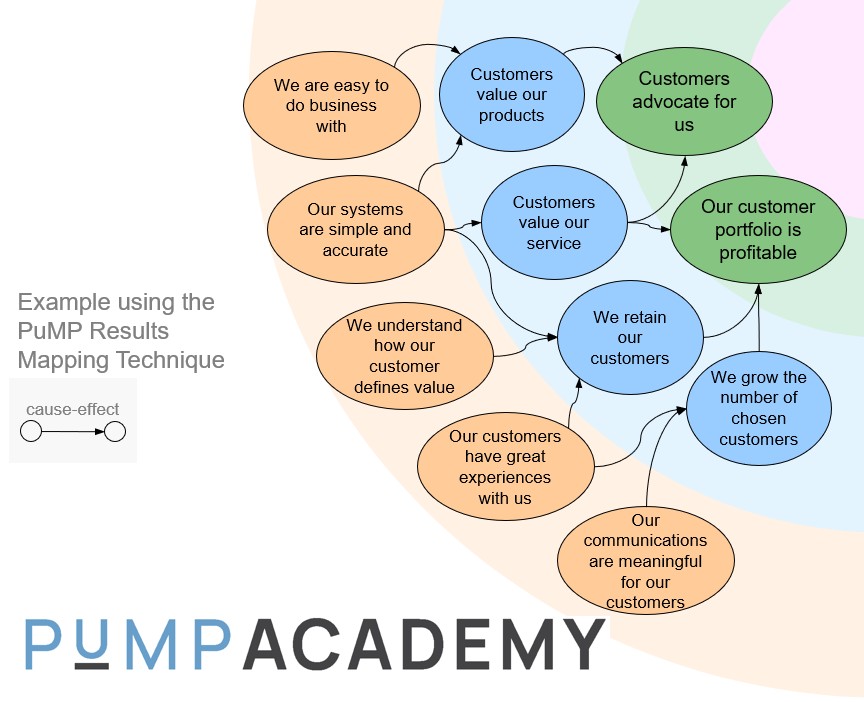
Customer Outcomes on a PuMP Results Map
If your expected outcome is that, ‘our customers are advocates of what we do’, then you need to measure that, and quantify the benefit you receive.
If your intended outcome is to grow specific customer groups, then Customer Lifetime Value (which has been around for about 20 years and fully researched by universities such as Wharton Business School and University of Maryland) offers a way to quantity the benefits from investing into the journey and experience your chosen customers receive.
A recent (June 2025) McKinsey article argues that the alignment between the CMO and CFO is essential for long term success. Quoting Mark-Hans Richer, EVP Fortune Brands “The relationship between the CMO and CFO is critical to the success of a business.” In other words, if we are seeking to fund a meaningful customer strategy, then we need to be clear about the expected payback for the organisation.
(see also: Profit By Design Key Principles)
3: The cost/benefit analysis and prioritisation.
There are often lots of initiatives listed in a customer strategy (we seek to improve this, reduce that etc…). However, two questions must be asked. Firstly, why should we fund these initiatives? Secondly, we only have limited capacity to work on improving the business, so what are the priorities? The must have changes?
Once we have completed – or at least attained our first draft of our customer portfolio analysis. (Note that this analysis will be ongoing, with new insights appearing from time to time to update our understanding). Which is: (a) identify our specific customer groups, (b) understand the value exchange with these customer groups, and (c) what we would like to do with these specific groups (for example: grow, retain, re-engineer, end the relationship).
We can then start to figure out what the activities might be with each of these customer groups. This becomes the action part of the strategy.
(On this page: Profit by Design the book – you will be able to download a folder with templates that will help with your analysis of the customer portfolio and planning.)
Often when we have done this analysis, we find ourselves wanting to “do” lots of activities with the customer groups. These activities then become the action part of the strategy. To make this prioritisation sensible and actionable, they should be split into potentially three groups
- The Obvious Must Do – these are the ones where there is a clear benefit for the business, and probably some benefit for the customer. These initiatives can be funded within the plan and with the available resources of the organisation.
- Experiments – some of the ideas we develop should probably be tested first. This testing allows us to learn more about the effects of a particular idea, or learn more about how it could be implemented. Having experiments allows us to test specific ideas or concepts prior to fully committing.
- Parking Lot – these initiatives or ideas are not ready for implementation, or are not selected for action just yet.
This, of course is a form of prioritisation.
Too often our customer strategies have too many things to do in them. In my experience this produces one of three possible results (and sometimes all three).
1. Too many things to do and nothing gets done well.
2. Too many things to do and we pretend that we did them all well.
3. Frustration, over-worked teams and no learnings.
In summary.
Addressing these three areas (above) in your customer strategy, ensures it will be far more meaningful for the organisation.
Every organisation needs a customer strategy. Whether you are a commercial (for profit) business, or a not-for-profit, or non-profit entity, you will be interacting with clients, customers or whatever you call them… You interact with people to provide services and interact with them in ways of delivering value in various contexts.
Do not allow your organisation to be full of assumptions about what is important and for whom. This only produces greater levels of waste.
Ensure you have a strategy with clear customer/client groups. Understand the two-way value exchange with your clients.
Be clear about the outcomes you seek. For your clients and as an organisation.
Make decisions on where to apply improvement effort, within the capacity you have. Where to experiment. And where to hold off until further capacity or insight arrives.
Read more in: The New Path to Profitability and Engagement
And in terms of the clear outcomes and measurement, have a look at:
The Eight Steps to a High Performing Organisation.
Featured image photo by UX Indonesia on Unsplash