
This article digs deep into our workplace culture and the influence leaders have on the way we work and how we work.
After the discussion on how leaders influence the workplace culture, the article then dives into how to create a ‘high-performance’ workplace culture. And importantly the role leaders play in this.
In short, having a positive, harmonious and productive workplace culture is a blend of:
- the way the work gets done, which is set by the leaders, the elements discussed below under How to create a high-performance culture) and
- how the work gets done – the interpersonal way that we work together, those behaviours that are demonstrated and modelled in the behaviours of the leaders.
The final section of this article dives into what you can do if you are in a toxic workplace culture.
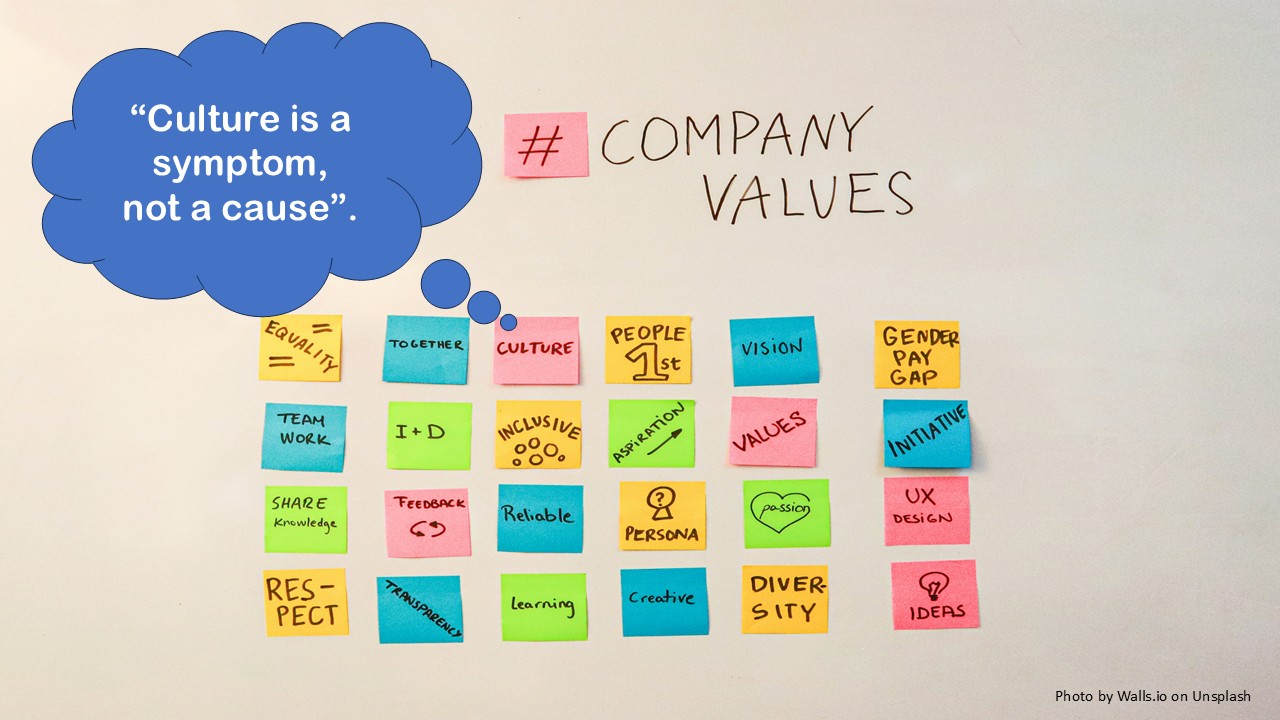
“Culture is a symptom, not a cause.”
I recently co-presented a webcast with Stacey Barr (entitled the Strategy Alignment Problem, replay here).
At one point Stacey made the statement: “Culture is a symptom, not a cause”. This really struck me as leaders often talk about their culture as something that, “is” rather than something that they “influence”.
I later discovered that the quote, “Culture is a symptom, not a cause,” is attributed to Harrald Matzke, former CEO, Managing Director and co-owner of cubus (a Serviceware Company based in Germany).
Leaders and managers influence culture
So often I hear leaders saying the problem is the culture of the organisation. Which will then lead to redefining the culture or bringing in culture experts to run a program with the aim of changing the culture. Changing the culture of the organisation means changing the way people think and feel about the workplace. Changing the collective behaviours.
However, it is the behaviour of the leaders that that has the biggest impact on the workplace culture. The accepted behaviours of the leaders and managers create the behaviours that are “the norm here”. The workplace culture.
The leaders set the tempo and tone of the organisation.
The workplace culture is actually a symptom of the ‘allowed behaviours’ in the organisation.
And it is the behaviours of the leaders that set the tone of what behaviours are allowed. These accepted behaviours flow on into the next level management, to team leaders and how people engage and work here.
The “mindset” of the teams is very much influenced by what the leader/s allow in the organisation. The “strictly hierarchical leadership” does not work today, people are seeking more from their time at work than getting paid. They also seek meaningful things to do and want to feel they are making a positive impact.
Two types of leader behaviours.
- Being civil and creating a culture that is productive and harmonious,
- Setting the workplace environment with clarity of purpose and evidence of progress towards meaningful goals. These ideas are reinforced by research in the Progress Principle. Which is: “the single biggest day to day motivator on the job is making progress in meaningful work”.
The organisation’s culture is a symptom of the leader’s behaviours.
Perhaps instead of leaders saying “our culture in not productive and we need to fix (the people) who have this culture”. The leaders can look at their own behaviours and seek to understand how these behaviours are creating the culture.
If a different workplace culture is desired, then the leadership team could – or should – define the behaviours are will support this new culture. Then hold each other accountable to those behaviours.
How to create a high-performance culture
These are some of the behaviours leaders need to adopt, to support the development of the culture they want for the workplace.
(drawn here from Stacey Barr’s book Prove it!)
Direction
Having a clear direction ensures that everyone knows where we are going, what outcomes and impact we contribute to. This clarity of purpose allows everyone to see the difference they intend to make with each client group. Being clear about this also makes it measurable. The key PuMP techniques for this are measurability test and results mapping. When leaders set a clear direction and stick to, there can be genuine buy-in from the people within the organisation, and no sense of “changing the goal posts” all the time. People can feel that they are working on something important, rather than just working in the business.
Evidence
Not having “vanity metrics” you know, the targets and numbers that make leaders feel good, but we all know they do not really matter. Evidence here is having clear performance measures providing evidence of the impact we are having on the chosen results. This promotes a learning culture, rather than a culture based on judgement (such as: “you did or didn’t hit your numbers”).
Execution
Implementing a strategy must deliver a return on investment. That return is not just measured in dollar terms. That return can also be measured on the impact we have made to the results that matters to us, and our customers. Combined with a clear direction and meaningful evidence, this allows people to get curious about what the root causes of performance improvement can be. The focus is on the processes and systems within the broader organisation.
Decision
With the previous elements in place, people want to work here, want to contribute to something bigger than themselves. This contributes to a voluntary sense of buy-in. The rewards are seeing improvement (evidenced by the performance measures).
Action
The people in the organisation are motivated to action when the targets are set in a meaningful manner. It’s not a matter of hit or miss, but how close can we get to that target. This becomes intrinsically rewarding. Seeking collaboration and being practical about improvement.
Learning
Once the leaders have set the scene with the previous points, this allows the people of the organisation to experiment and discover ways to improve. There is no failure, only feedback. The only failure could be if we failed to learn something from our improvement efforts.
Further content on developing a performance culture:
International Institute of Directors and Managers (6 minute video)
Business Leadership Today (article and audio/podcast)
The short summary
Having a positive, harmonious and productive workplace culture is a blend of:
- the way the work gets done, which is set by the leaders (such as those elements above under How to create a high-performance culture) and
- how the work gets done – the interpersonal way that we work together, those behaviours that are demonstrated and modelled in the behaviours of the leaders.
Related articles:
Eight Steps to a High Performance Organisation
How to close the strategic gap
This article appeared in the American Society for Public Administration Centre for Accountability and Performance
Digging a little deeper into this discussion on workplace culture…
Workplace culture is not the root cause of the problems.
Lecturer of Leadership at Edith Cowan University, Andrei Lux says: “Most of us will experience incivility at some point at work. More than 50% experience it weekly. According to a 2022 meta-analysis of 105 incivility studies, you’re more likely to cop it if you’re new, female, in a subordinate position, or from an ethnic minority.”
And adds: “Leadership sets the tone. We’re social creatures and learn what’s expected and acceptable from those we look up to. Our leaders’ behaviour is infectious, and cascades down throughout and across organisations – for better or worse.”
_________
In 2023 after, “years of headlines about the toxic workplace culture at (the Australian) Federal Parliament, codes of conduct” were introduced for the first time and applied to all parliamentarians and staffers. (source)
_________
Research into workplace incivility (defined as: “low-intensity deviant workplace behaviour with an ambiguous intent to harm”), according to Wiley has taken off (2014)
_________
What to do if you are in a “toxic workplace culture”
This ABC article, Dr Megan Woods (University of Tasmania) senior lecturer in occupational and workplace health and safety has a few suggestions.
Firstly, be aware of the what you are seeing, hearing and feeling.
Secondly, acknowledge it. Talk about it. Discuss it personally with your colleagues, managers and leaders (that is not just online).
Thirdly, back up your colleagues. A toxic workplace culture requires people step up.
Fourthly, consider reporting it.
_________
Featured image/Photo by Walls.io on Unsplash