
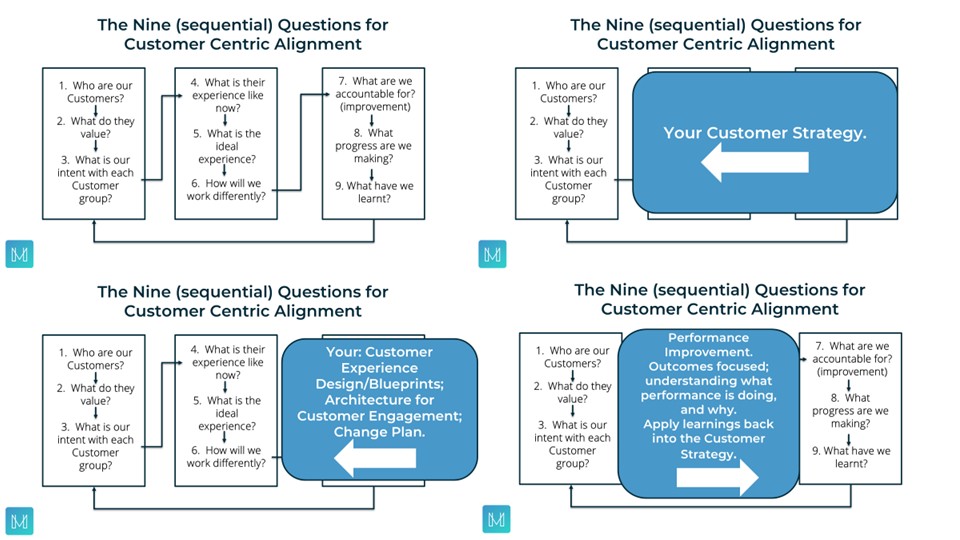
Uncovering your answers to these nine key questions – in this specific sequence – will ensure you can move towards greater levels of customer centric alignment.
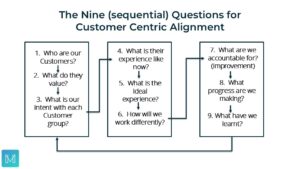
Nine Questions for Customer Centric Alignment
The three questions relating to your customer strategy.
These three questions are really about getting clear on who your customers are and why they engage with you. Once you have a fundamental understanding of this you can then tailor your customer engagement to enhance maximum value for the customer and for the business.
These key principles are also part of the Profit by Design approach.
How to create your Customer Strategy.
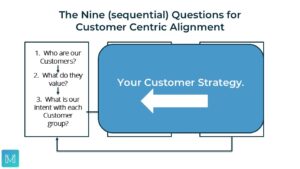
The three questions relating to your customer strategy.
Who are our customers?
Most organisations see their customers through the lens of what the customer does. How they interact with you. How you interact with them. Your perception of what they want etc…
However, these customers are interacting with you, based on what they need, want and/or value from you. This is their ‘perceptions’ of the value they expect to receive. Which often varies from what you believe your customers are looking for.
How these customers interact with you directly affects your costs. Service costs, product/service margins and advocacy (whether they give you positive word-of-mouth, or not. NPS).
What do they value…?
Customers typically assess the value they receive from you in four broad categories.
Firstly, in terms of the goals they expect from what you provide. This is often an overall expectation from their interaction with you. Whatever you are providing, there will be an expectation of some sort of goal to be achieved. This is often the overarching idea of value, but is influenced by these other elements.
Secondly, the result or outcome they got from their interaction with you. Was the transaction successful in the mind of the customer? Did they get what they expected? This differs of the expected goals in a more transactional way. The overall goal might have been realised, but the result or outcome was not quite up to what they expected.
Thirdly, the customer’s perception of value is dominated by the overall, end-to-end experience during the delivery of the goal, result and/or outcome. You may have delivered an excellent goal or result for the customer, but what was their experience like on that journey…? This will significantly affect their overall perception of value.
Fourthly, community. Why do people wear the sports shirts of their favourite team…? Harley-Davidson riders love to wear HOG merchandise… How often do we see people in the supermarkets wearing shirts with words such as The Beatles, or Metallica, or the logo of the Rolling Stones …? Answer: Community.
Many people get value from feeling they belong to a community. Or showing that they belong to a community of people that support the Brisbane Lions, or the San Francisco 49ers. People (and therefore customers) can get value from belonging to a community, and gaining value from that community they belong to… Understanding and respecting this element of customer value can help you refrain from making a blunder (as with Starbucks in South Korea, also).
What is our intent with each Customer group?
Now you ‘know’ who your customers are (the specific groups), what they value, and the value they represent to you. Your next challenge in this customer centric alignment is to determine what your intent is with each customer group.
The table below gives you a range of options to consider with your various customer groups.
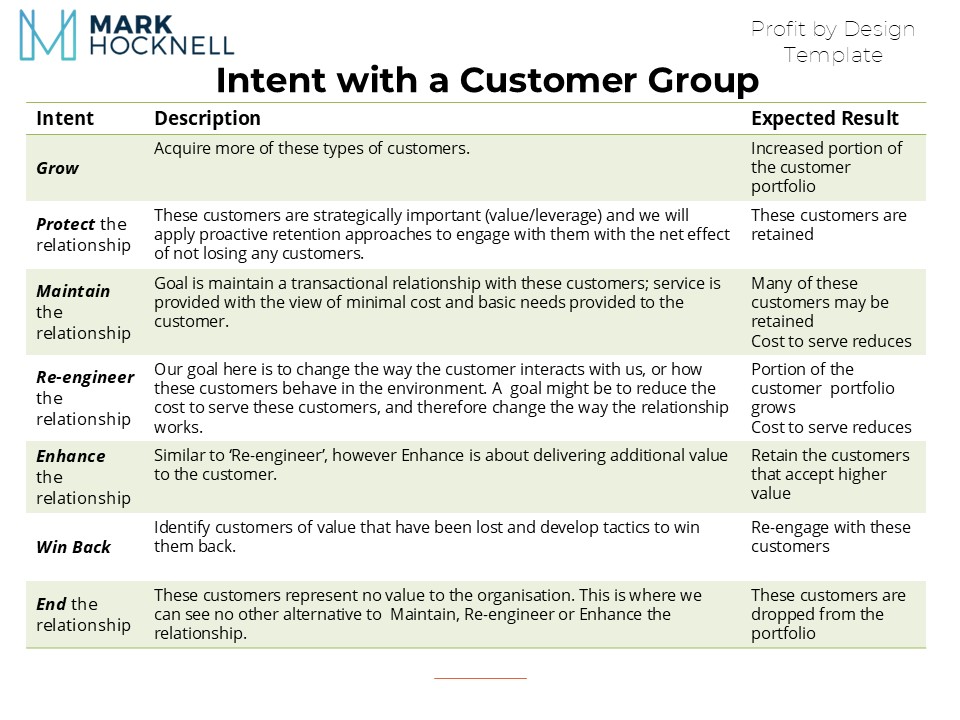
Profit By Deisgn Template – Intent with a Customer Group
Being clear on your intention with each group is critical to being clear about your actions taken with each group. As your portfolio of customers changes over time, your combined costs and revenue from the total portfolio with also alter. Matching your intent with customer groups with your longer-term organisational outcomes.
(This is part of the Profit By Design approach, and the templates are available for free download for here.)
The Three Questions about your Customer Experience and the Change Plan.
The first part of this is getting a clear understanding of how you are currently performing. What is the experience your customers have now? Is that in alignment with your intent with each customer group?
The systems and processes you have in place underpin the services and experience you deliver for your customers. So, let’s discuss how we develop a measurement framework.
When it comes to measurement, we do not want to begin with brainstorming a list of KPIs. Instead, let’s be clear about the outcomes we want to achieve. And by achieve, I mean the ultimate outcome we want, and then use performance measures to see how close we can get to that outcome.
Using the PuMP Academy method, we first develop Results Map, which is a simple, cause and effect flow of the outcomes we would like to work towards. Example below.
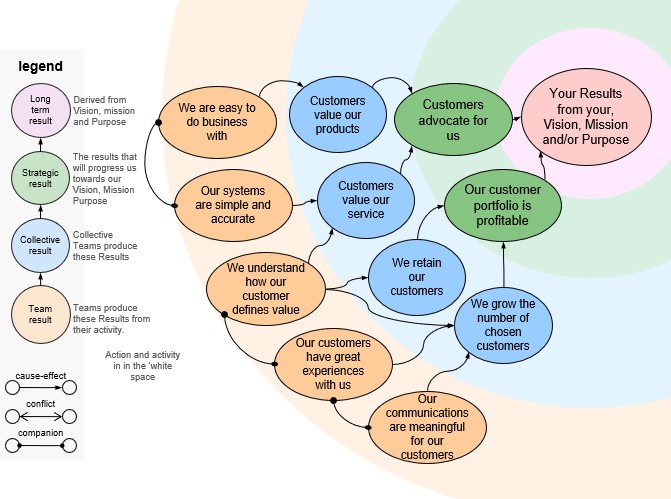
Customer Portion of a Results Map (PuMP Step 2)
Once we have these outcomes, we can then design and select performance measures for each of these Results. This gives us our performance measures in a cause-and-effect framework. With this approach, the level of causality becomes measurable. Which means we can learn how to find the leverage points for our performance improvement effort.
(More on this approach here, and here and on this page.)
We can now compare the experience of our customers, with the experience we wish to provide, our intent with our chosen/various customer groups.
Understanding this difference allows us now to determine how we will work differently to get closer to our outcomes with our specific customer groups.
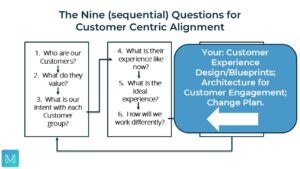
The Three Questions about your Customer Experience and the Change Plan.
The Third Set of Three Questions
Note that this is an evidenced-based approach. It’s not opinion based. So much time, effort and employee engagement is lost during debates where people have various opinions on what performance is currently doing and how to change it.
When we have the evidence, from our Results and Performance Measures, we can make more informed decisions. Whilst at the same time, taking an experimental mindset on how to improve. Learning what makes a difference, evidenced by the performance measures. And, from this, we can determine how we will work differently, to more us closer to the customer outcomes we seek.
Accepting accountability for learning how to improve. Not the dichotomy between hit or miss targets. Using evidence to know where progress is being made and where it is son, and why. Giving us the insights and learnings on how to get greater levels of customer centric alignment, between the value our chosen customers seek and the value we deliver.
Conclusion
Uncovering your answers to these nine key questions – in a specific sequence – will ensure you can move towards customer centric alignment.
Nine key questions in a specific sequence. Your answers to these nine key questions will ensure you can move towards greater levels of customer centric alignment.
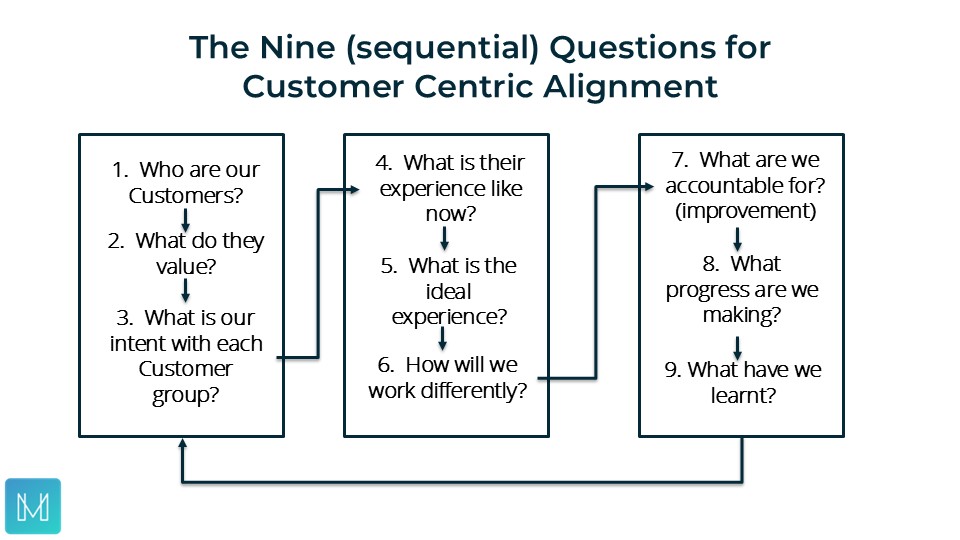
The Nine (sequential) Questions for Customer Centric Alignment